Follow us
Latest News & Events


p16/Ki-67 Dual-Stain Immunofluorescence: A Complete Guide for Cervical Cytology Screening
Introduction: The Challenge of Cervical Cancer Screening
Cervical cancer remains one of the most preventable cancers worldwide, yet accurate screening continues to challenge pathology laboratories. Liquid-based cytology (LBC) and Liquid-Based Cytology (LBC) have improved specimen quality, but interpretation variability persists — particularly for borderline lesions and cases with overlapping cellular features.
The p16/Ki-67 dual-stain approach has emerged as a powerful adjunct to conventional cytology. When combined with immunofluorescence (IF) technology rather than traditional immunohistochemistry (IHC), this method offers superior sensitivity, specificity, and compatibility with AI-assisted diagnosis.
This comprehensive guide explores the clinical application of p16/Ki-67 dual-stain immunofluorescence in cervical cytology, based on a 599-case clinical study and KFBIO‘s fluorescence scanning platform.
Why p16/Ki-67 Dual Staining Matters
The Biological Basis
p16 (CDKN2A) is a tumor suppressor protein that becomes overexpressed when the retinoblastoma (Rb) pathway is disrupted by high-risk HPV infection. Ki-67 is a proliferation marker expressed in actively cycling cells.
Under normal conditions, p16 and Ki-67 expression are mutually exclusive:
- Normal cells: Either p16+ (cell cycle arrest) OR Ki-67+ (proliferating), but not both
- Abnormal cells: p16 and Ki-67 co-expression indicates cell cycle dysregulation — a hallmark of HPV-transformed cells
Key Insight: The co-expression of p16 and Ki-67 within the same cell indicates cell cycle dysregulation, independent of cytomorphology. A positive dual-stain result has high positive predictive value for cervical precancerous lesions.
Advantages Over Conventional Cytology
| Parameter | Conventional Cytology | p16/Ki-67 Dual Stain |
| — | — | — |
| Sensitivity for HSIL | Variable (60-80%) | >95% |
| Inter-observer variability | High | Low |
| Detection of occult lesions | Limited | Enhanced |
| AI compatibility | Moderate | Excellent |
| Sample requirement | Standard | Same slide (no additional sample) |
Limitations of Traditional IHC Dual Staining
While IHC-based p16/Ki-67 dual staining has demonstrated clinical utility, several limitations affect its adoption:
1. Color Interpretation Challenges
In IHC dual staining:
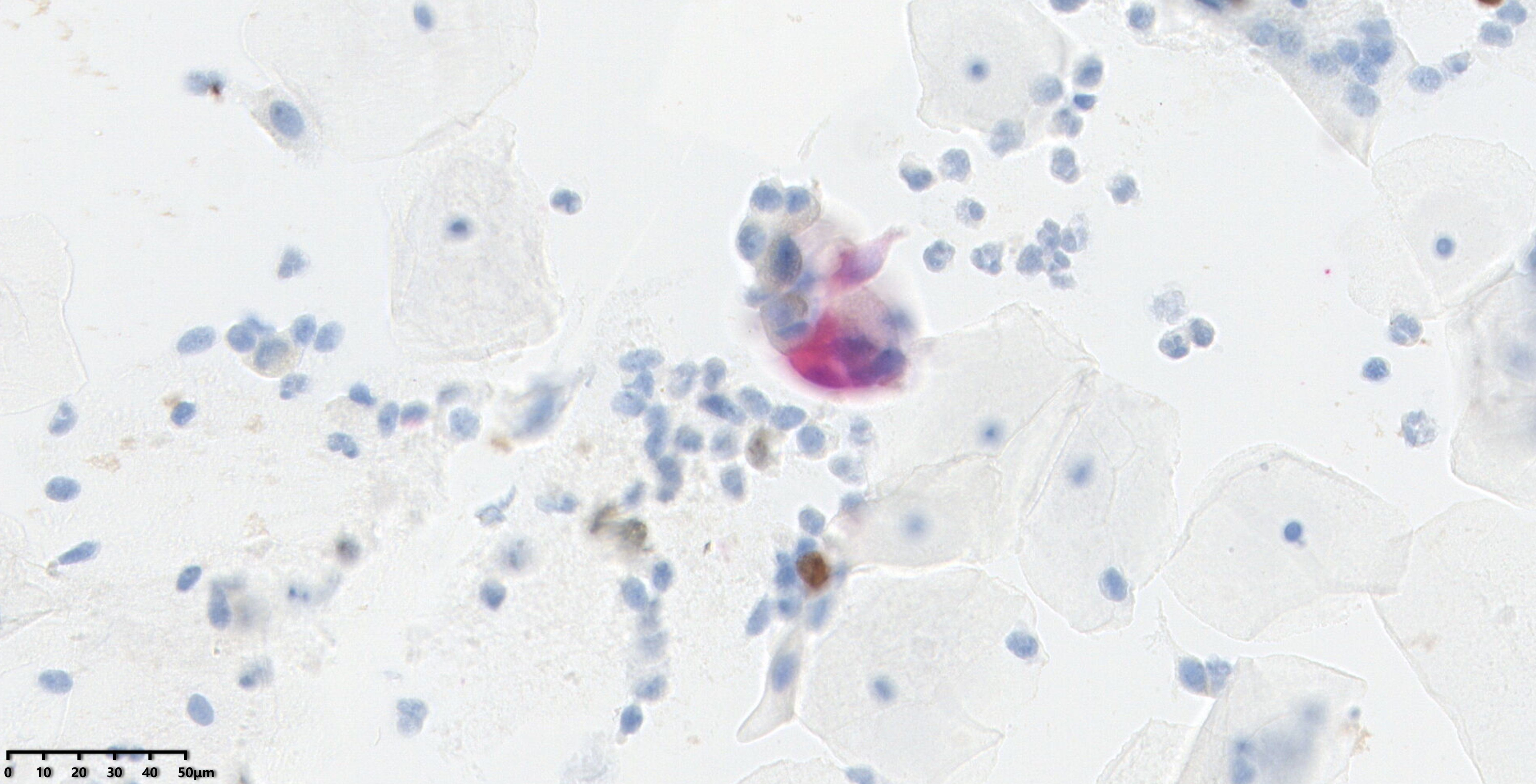
- p16: Typically brown (cytoplasmic and nuclear)
- Ki-67: Typically red (nuclear)
Problem: When both markers are present in overlapping cells, color mixing can obscure results. Distinguishing between:
- True dual-positive cells (both stains in same cell)
- Adjacent single-positive cells
- Background staining
This ambiguity leads to inter-observer variability and diagnostic uncertainty.
2. Inconsistent Staining Quality
Variations in experimental methods, reagents, and workflows among laboratories lead to inconsistent staining, including differences in:
- Staining uniformity
- Intensity
- Background levels
3. Non-Reproducible Specimens
Cytology specimens cannot be replicated into identical slides. Even when the same sample is used for HPV testing, cytology, and p16/Ki-67 dual staining, identical cellular composition cannot be reproduced.
4. Lack of Standardized Workflows
Standardized dual-staining workflows have not been fully established. Strict quality control is required to ensure result reproducibility.
5. Cell Cluster Evaluation
Although interpretation is simpler than cytomorphology alone, evaluation of cell clusters remains challenging. Achieving high-quality automated and AI-assisted interpretation requires strong technical capability.
Immunofluorescence Dual Staining: The Superior Alternative
Immunofluorescence (IF) dual staining addresses the limitations of IHC by using spectrally distinct fluorescent labels instead of chromogenic substrates.
Technical Principles
TSA-based fluorescent labeling uses known antibodies that specifically bind to target proteins (based on the same principle as immunohistochemistry). Upon excitation with light at specific wavelengths, fluorescence is emitted, enabling:
- Precise intracellular protein localization
- In situ localization
- Quantitative AI-based analysis
Key Advantages Over IHC
| Challenge | IHC Dual Stain | IF Dual Stain |
| — | — | — |
| Color overlap | Common problem | Avoided — spectrally distinct |
| Detection accuracy | Moderate | High |
| Sensitivity | Lower | Higher |
| AI compatibility | Limited | Excellent |
| Background removal | Manual | Automated |
| Multiplex capability | 2-3 markers | 6-8 markers |
Fluorescent labeling avoids color overlap that may occur in chromogenic systems used in traditional IHC dual staining, thereby improving detection accuracy and sensitivity.
The technique preserves true cellular in situ characteristics, facilitating:
- More efficient AI-assisted interpretation
- Simplified experimental workflows
- Elimination of signal interference
- Background removal
- Significant improvement in detection efficiency and accuracy
Clinical Study: 599-Case Performance Evaluation
A comprehensive clinical study evaluated immunofluorescence dual staining in 599 LBC cases, demonstrating significant improvements in diagnostic accuracy.
Study Design
| Parameter | Value |
| — | — |
| Total cases | 599 |
| Slide preparation success rate | 98.83% |
| Method | IF dual stain on LBC slides |
| Compatibility | Does not affect LBC morphology |
Detection Rates by Cytology Category
| LBC Diagnosis | Total Cases | Dual-Stain Positive | Positive Rate | High-Grade Detection |
| — | — | — | — | — |
| NILM | 217 | 10 | 4.61% | — |
| ASC-US | 77 | 23 | 30.67% | — |
| LSIL | 131 | 43 | 33.33% | — |
| ASC-H | 68 | 64 | 95.52% | 97.1% |
| HSIL | 103 | 99 | 98.02% | — |
| SCC | 3 | 3 | 100% | — |
| Overall | 599 | 242 | — | 97.1% |
Key Findings
1. High-Grade Lesion Detection
The high-grade detection rate of immunofluorescence dual staining showed high concordance with LBC diagnoses (97.1%).
2. ASC-H Risk Stratification
Among 68 ASC-H cases, 95.52% were dual-stain positive, providing clear guidance for clinical management.
3. LSIL Triage
Among 131 LSIL cases, 33.33% were dual-stain positive, indicating which patients require closer surveillance.
4. LBC Diagnosis Correction
Among 149 LBC cases initially diagnosed as high-grade, 3 cases were not detected by immunofluorescence dual staining. After LBC slide review, these cases were considered not to meet high-grade LBC criteria, leading to a corrective revision of the original LBC diagnosis.
5. Adenocarcinoma Detection
The method demonstrated high diagnostic accuracy for adenocarcinoma detection (98.66%), addressing a known limitation of conventional cytology.
False-Positive Analysis
Most false-positive results were attributed to cell overlapping. AI-based analysis can be optimized to specifically reduce the priority of overlapping cell clusters, thereby improving diagnostic accuracy.

AI Integration: Precision Colocalization
The AI Advantage
Immunofluorescence dual staining is inherently compatible with AI-assisted image analysis. The KFBIO AI platform enables:
- Precise colocalization of p16 and Ki-67 signals
- Automated cell detection and classification
- Quantitative analysis of signal intensity
- Reduced inter-observer variability
Workflow Integration
1. LBC slide preparation — Standard liquid-based cytology
2. Immunofluorescence staining — p16/Ki-67 dual stain on same slide
3. Digital scanning — KFBIO KF-FL Series fluorescence scanner
4. AI analysis — Automated detection of dual-positive cells
5. Pathologist review — Confirm AI findings with morphology
AI-enabled precise colocalization significantly improves diagnostic consistency and accuracy.
Practical Implementation with KFBIO
Equipment Requirements
| Component | Recommendation |
| — | — |
| Scanner | KFBIO KF-FL Series (fluorescence) |
| Filters | DAPI, FITC, TRITC (standard) |
| Software | KF-PIMS + AI analysis module |
| Storage | Standard WSI storage (1-3 GB/slide) |
Staining Protocol Overview
1. LBC slide preparation — Standard procedure
2. Fixation — Maintain cellular morphology
3. Permeabilization — Enable antibody access
4. Primary antibodies — Anti-p16, anti-Ki-67
5. Fluorescent secondary antibodies — Spectrally distinct fluorophores
6. Counterstain — DAPI for nuclear visualization
7. Mounting — Antifade mounting medium
Quality Control Points
- Verify antibody specificity with control slides
- Confirm fluorophore separation (no spectral overlap)
- Check staining uniformity across slide
- Validate signal-to-noise ratio
- Confirm DAPI nuclear counterstain quality
Beyond Cervical Cytology: Multiplex Applications
The immunofluorescence platform extends beyond p16/Ki-67 dual staining to support multiplex antibody detection across various cytology applications.
Serous Effusion Cytology
Example: Lung Adenocarcinoma Detection
After Pap staining, brightfield scanning revealed only a small number of atypical cells in a pleural effusion specimen. Immunofluorescence staining of the same field of view demonstrated dual positivity for:
- TTF-1 (green) — Thyroid transcription factor-1
- Napsin A (red) — Surfactant protein
This result supported the diagnosis of lung adenocarcinoma, demonstrating the power of multiplex IF on paucicellular specimens.
Urine Cytology
Multiplex Panel: HK2 + pan-CK + CD45
Target cells: CD45− / HK2+ / pan-CK+ / DAPI+
This approach enables:
- Urothelial carcinoma detection
- Single-cell sequencing from positive target cells
- Bladder cancer screening in high-risk populations
Immune Microenvironment Analysis
Multiplex immunofluorescence enables quantitative analysis of up to 6-8 markers on a single tissue or cytology slide, allowing:
- Standardized identification of immune cell types
- Spatial context preservation through marker colocalization
- Tumor immune microenvironment (TIME) analysis
Applications:
- Immune checkpoint inhibitor response prediction
- Tumor-infiltrating lymphocyte (TIL) quantification
- Myeloid-derived suppressor cell (MDSC) analysis
Clinical Decision Support: How Results Guide Management
Risk-Based Triage Algorithm
| Cytology Result | IF Dual-Stain Result | Recommended Action |
| — | — | — |
| NILM | Negative | Routine screening |
| NILM | Positive | Colposcopy referral |
| ASC-US | Negative | Repeat HPV/cytology in 12 months |
| ASC-US | Positive | Colposcopy referral |
| LSIL | Negative | Observation or repeat cytology |
| LSIL | Positive | Colposcopy referral |
| ASC-H | Positive | Immediate colposcopy with biopsy |
| HSIL | Positive | Treatment (LEEP/CKC) |
Economic Impact
By identifying patients who truly require colposcopy:
- Reduced unnecessary procedures
- Improved resource allocation
- Decreased patient anxiety
- Earlier detection of high-grade lesions
Comparison: IF vs IHC vs Flow Cytometry
| Parameter | IHC Dual Stain | IF Dual Stain | Flow Cytometry |
| — | — | — | — |
| Sample type | Tissue/cell block | Same cytology slide | Cell suspension |
| Morphology preserved | Yes | Yes | No |
| Spatial context | Yes | Yes | No |
| Multiplex capacity | 2-3 markers | 6-8 markers | 10+ markers |
| AI compatibility | Moderate | Excellent | Limited |
| Quantitative | Semi | Yes | Yes |
| Paucicellular samples | Challenging | Optimal | Requires sufficient cells |
Summary: Key Takeaways
For Pathologists
1. IF dual staining overcomes IHC limitations — No color overlap, clearer interpretation
2. High concordance with LBC — 97.1% high-grade detection rate
3. AI-ready workflow — Enables automated analysis
4. Single-slide solution — No additional sample needed
For Laboratory Managers
1. Improved efficiency — Reduced repeat testing
2. Standardized interpretation — Less inter-observer variability
3. Multiplex capability — 6-8 markers from single slide
4. Compatible with existing LBC workflow
For Clinicians
1. Clear risk stratification — Positive/negative result guides management
2. Earlier detection — Occult lesions identified
3. Reduced false positives — Cell overlapping managed by AI
4. Adenocarcinoma detection — Addresses cytology limitation
Recommended Equipment: KFBIO KF-FL Series
The KFBIO KF-FL Series fluorescence scanner is optimized for immunofluorescence dual staining applications:
| Feature | Specification |
| — | — |
| Fluorescence channels | Up to 10 channels |
| Camera | High-sensitivity sCMOS |
| Scanning technology | Area scanning |
| Resolution | 0.25 µm/pixel at 20× |
| Slide capacity | 5-400 slides |
| Scan time | ≤6 min/slide (3-channel) |
| AI integration | Native support |
Frequently Asked Questions
How does immunofluorescence dual staining differ from traditional IHC?
Immunofluorescence uses fluorescent labels instead of chromogenic substrates, eliminating color overlap issues and enabling clearer detection of dual-positive cells. It also preserves spatial context and is inherently compatible with AI analysis.
Does IF staining affect the original LBC slide?
No. Immunofluorescence staining is performed on the basis of LBC-stained slides and does not affect LBC morphology. The original cytological interpretation remains available for correlation.
What is the minimum cellularity required?
Immunofluorescence dual staining requires only a small number of target cells, making it ideal for paucicellular samples. The 599-case study demonstrated a 98.83% slide preparation success rate.
How are false positives addressed?
Most false-positive results are attributed to cell overlapping. AI-based analysis can be optimized to specifically reduce the priority of overlapping cell clusters, thereby improving diagnostic accuracy.
Can this method detect adenocarcinoma?
Yes. The clinical study demonstrated 98.66% diagnostic accuracy for adenocarcinoma detection, addressing a known limitation of conventional cervical cytology.
References
1. Expert Consensus on p16/Ki-67 Immunocytochemical Dual-Staining Detection in Cervical Cytology (2023)
2. KFBIO Clinical Applications Team. Immunofluorescence dual staining in cervical cytology: 599-case performance evaluation. Internal data. 2023.
3. Xu Haimiao. Advances in the Application of Immunofluorescence Techniques in Cytopathology. Presented at KFBIO Clinical Symposium. 2023.
© 2026 KFBIO. All rights reserved. This article provides clinical and technical information for educational purposes. Clinical decisions should be made in consultation with qualified healthcare professionals.